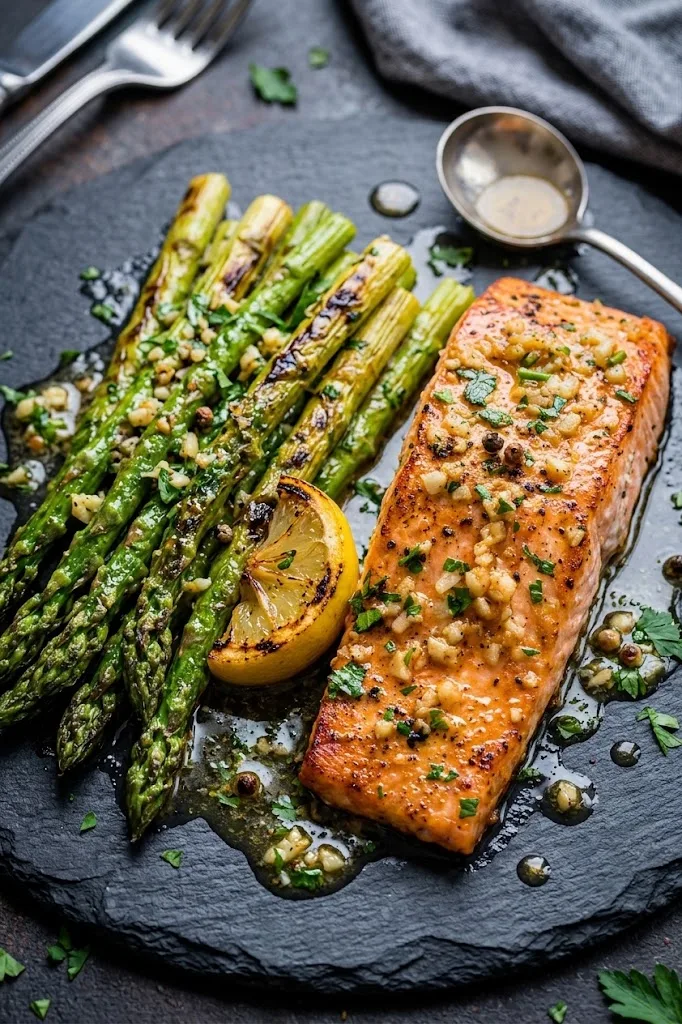
This Baked Salmon in Foil with Asparagus and Lemon Garlic Sauce is an effortless, flavorful dinner that feels special enough for entertaining but is simple enough for a busy weeknight. Tender salmon cooks gently alongside crisp-tender asparagus while a bright lemon-garlic sauce infuses every bite with buttery, savory flavor. Naturally high in protein and low in carbohydrates, it is a wholesome, satisfying meal with minimal cleanup.
Can This Recipe Support Weight Loss Goals?
Yes, it can fit comfortably into a balanced weight-management eating pattern. Salmon provides substantial protein and healthy fats, while asparagus adds fiber and volume with relatively few calories and carbohydrates. The recipe is nutrient-dense and satisfying, although the butter and olive oil are calorie-dense, so adjusting their portions can help manage total calories.
Does Baked Salmon with Asparagus Fit a High-Protein Lifestyle?
Absolutely. Salmon is the primary protein source, providing a substantial amount of high-quality protein in every serving.
Asparagus contributes fiber, vitamins, minerals, and very few net carbohydrates.
The lemon-garlic sauce adds flavor without relying on sugar or high-carb ingredients.
With approximately 35–40 g of protein per serving, this recipe is an excellent fit for a high-protein, low-carb dinner.
Why This Recipe is Special
- High-protein: Salmon provides a satisfying protein-rich centerpiece.
- Low-carb: Salmon, asparagus, lemon, garlic, and herbs keep carbohydrates naturally low.
- One-pan convenience: Foil packets make cooking and cleanup exceptionally easy.
- Bright & buttery: Lemon and garlic balance the richness of salmon beautifully.
- Tender every time: Foil helps retain moisture while the fish bakes.
My Personal Experience
- The foil packet keeps the salmon incredibly tender.
The trapped steam helps prevent the fish from drying out during baking. - The lemon-garlic sauce makes the whole dish taste brighter.
A little acidity cuts through the richness of the salmon and butter. - Asparagus cooks beautifully alongside the fish.
It becomes tender while still retaining a pleasant bite. - Cleanup is one of my favorite things about this recipe.
Once dinner is finished, there is hardly a pan to scrub.
Perfect For
This recipe is ideal for busy weeknight dinners, high-protein meal prep, low-carb meal plans, keto-style dinners, healthy family meals, date-night dinners, spring and summer entertaining, and quick nutritious lunches.
Why You’ll Love This Recipe
- Minimal cleanup
Everything cooks inside a foil packet, keeping the baking sheet nearly spotless. - Naturally high in protein
A generous salmon fillet makes this a satisfying protein-focused meal. - Low in net carbs
Asparagus and the lemon-garlic sauce contribute very few carbohydrates. - Ready quickly
The entire meal can be prepared and baked in well under an hour. - Restaurant-worthy flavor
Lemon, garlic, butter, and herbs make simple ingredients taste luxurious.
Common Mistakes to Avoid
- Overcooking the salmon — Start checking early because fillets vary in thickness.
- Using very thick asparagus with thin salmon — The fish may finish before the asparagus becomes tender; choose similarly sized portions.
- Sealing the foil too tightly against the fish — Leave a little space for steam to circulate.
- Adding too much sauce — Excess liquid can cause the asparagus to steam rather than roast.
Required Equipment
- Rimmed baking sheet — Supports the foil packets and catches any accidental leaks.
- Heavy-duty aluminum foil — Creates a secure packet that retains moisture.
- Small mixing bowl — Makes combining the lemon-garlic sauce easy.
- Pastry brush or spoon — Spreads the sauce evenly over the salmon.
- Instant-read thermometer — Helps prevent overcooking and checks the salmon’s internal temperature.
Storage Instructions
Allow leftovers to cool and refrigerate them in an airtight glass or BPA-free food container within 2 hours of cooking.
The cooked salmon and asparagus will keep refrigerated for up to 3 days.
For best quality, freezing is possible for the salmon for up to 2 months, although the asparagus may become softer after thawing.
Reheat gently in a 160°C/325°F oven for 8–12 minutes or until warmed through. Avoid prolonged high heat because it can dry out the salmon.
Recipe Details
- Preparation Time: 10 minutes
- Cooking Time: 15–20 minutes
- Total Time: 30 minutes
- Servings: 4
- Best Season: Spring & Summer
- Total Calories (Per Serving): Approximately 430 calories (estimate)
Short Description
This Baked Salmon in Foil is tender, flaky, and infused with bright lemon-garlic butter.
Fresh asparagus cooks alongside the salmon for an easy one-pan meal with minimal cleanup.
Naturally high in protein and low in carbohydrates, it is perfect for a healthy weeknight dinner.
📝 Ingredients
For the Salmon & Asparagus
- 4 salmon fillets, approximately 6 oz (170 g) each
- 1 lb (450 g) fresh asparagus, woody ends trimmed
- 1 tablespoon extra-virgin olive oil
- ½ teaspoon salt
- ¼ teaspoon black pepper
- ½ teaspoon paprika, optional
- ½ teaspoon dried Italian herbs
Lemon Garlic Sauce
- 3 tablespoons unsalted butter, melted
- 1 tablespoon extra-virgin olive oil
- 4 cloves garlic, finely minced
- 2 tablespoons fresh lemon juice
- 1 teaspoon lemon zest
- 1 tablespoon fresh parsley, chopped
- ¼ teaspoon salt
- ⅛ teaspoon black pepper
- ¼ teaspoon red pepper flakes, optional
Ingredient notes: Choose salmon fillets of similar thickness so they cook at approximately the same rate. Fresh lemon juice gives the sauce a brighter flavor than bottled lemon juice.
Directions
- Preheat the oven — 5 minutes
Preheat to 200°C/400°F. Prepare four large sheets of heavy-duty foil on a baking sheet. - Prepare the asparagus — 3 minutes
Trim the woody ends and arrange the asparagus evenly in the center of each foil sheet. - Season the salmon — 2 minutes
Pat the salmon dry. Season both sides lightly with salt, black pepper, paprika, and Italian herbs. High-protein tip: Salmon is already protein-rich, so focus on keeping the fillet portion generous while using the sauce primarily for flavor. - Make the lemon-garlic sauce — 2 minutes
In a small bowl, whisk melted butter, olive oil, garlic, lemon juice, lemon zest, parsley, salt, pepper, and red pepper flakes. - Assemble the packets — 3 minutes
Place one salmon fillet over each portion of asparagus. Spoon the lemon-garlic sauce evenly over the salmon and asparagus. - Seal the foil — 2 minutes
Fold the foil over the ingredients and seal the edges, leaving a little air space inside the packet. Tip: Do not wrap the foil so tightly that it presses against the salmon. - Bake — 15–20 minutes
Place the packets on the baking sheet and bake at 200°C/400°F. Visual cue: The salmon should turn opaque and flake easily when gently pressed with a fork, while the asparagus should be bright green and tender-crisp. - Check doneness
For food safety, salmon should reach 145°F/63°C at the thickest part. - Open carefully — 1 minute
Carefully open the packets because hot steam will escape. - Finish and serve — 2 minutes
Spoon the sauce from the packet over the salmon. Garnish with fresh parsley and additional lemon wedges.
Nutrition Facts — Per Serving (Approximate)
| Nutrient | Amount |
|---|---|
| Calories | ~430 kcal |
| Fat | ~27 g |
| Cholesterol | ~100 mg |
| Sodium | ~410 mg |
| Potassium | ~1,050 mg |
| Total Carbohydrates | ~8 g |
| Fiber | ~4 g |
| Net Carbs | ~4 g |
| Sugars | ~3 g |
| Protein | ~39 g |
| Calcium | ~55 mg |
Nutrition values are approximate and depend on the salmon size, butter, oil, and seasoning amounts used.
Notes
- Storage: Refrigerate leftovers in an airtight container for up to 3 days.
- Freezing: Salmon can be frozen for up to 2 months; asparagus is best eaten fresh.
- Reheating: Warm gently at 160°C/325°F to help preserve moisture.
- Allergy notes: Contains fish and dairy.
- Dairy-free option: Replace butter with additional olive oil or a plant-based butter suitable for cooking.
- Low-carb tip: The recipe is naturally low in net carbohydrates; avoid serving it with sugary sauces.
- Flavor boosts: Add Dijon mustard, fresh dill, capers, chili flakes, or extra lemon zest.
- Protein-friendly serving: Pair with Greek yogurt-based sauce or another lean protein-rich side if you need a larger protein serving.
- Vegetable variations: Broccoli, green beans, zucchini, or thinly sliced bell peppers can replace some of the asparagus.
Frequently Asked Questions
1. Can I use frozen salmon?
Yes, but thaw it completely and pat it dry before seasoning for more predictable cooking.
2. How do I know when the salmon is done?
It should be opaque and flake easily, with an internal temperature of approximately 145°F/63°C for food safety.
3. Can I make this recipe without butter?
Yes, replace the butter with additional olive oil or a suitable plant-based butter.
4. Can I prepare the foil packets ahead of time?
You can assemble them several hours ahead and refrigerate them, but keep the salmon properly chilled until ready to bake.
5. Is this recipe keto-friendly?
Yes, the salmon, asparagus, lemon, garlic, and fats are all naturally low in carbohydrates, giving the dish approximately 4 g net carbs per serving in this estimate.
6. What sides go well with baked salmon?
Cauliflower rice, roasted broccoli, a leafy green salad, zucchini noodles, or a simple cucumber salad complement it especially well.